Long-Tail Keywords: What Are They, and How Do You Find / Use Them?
 Joram BoonSEO and content specialist
21 February 2024
Long-tail keywords are longer (3+ words), more specific search terms that often have a more specific search intent.
Long-tail keywords might have less search volume than short-tail keywords, but also less competition, and usually bring more relevant traffic that converts better!
In this article, you’ll learn everything about these keywords: what they are, how to find them, and how to use them effectively for your online store or website.
After reading this article, you’ll know how to attract more relevant visitors with less effort, visitors who convert. That’s every business owner or online store owner’s dream!
In Short, the Key Points...
- Long-tail keywords help you rank faster
- They attract more specific, relevant traffic to your website.
- The majority of all search queries consists of long-tail keywords.
- Use Google search features and long-tail keyword tools like Ahrefs and SEMrush to find long-tail keywords.
- Make your content strategy stronger with a long-tail strategy by using long-tail keywords during content creation.
Why Do Long-Tail Keywords Matter?
Quick Wins
With long-tail keywords, you hit the mark faster.
They’re USUALLY less competitive, which means you reach the top (the first page) of the search results faster.
This means quick wins in SEO and more visibility for your website.

Targeting More Relevant Traffic
Long-tail keywords come with a more specific search intent, people’s requirements and search intent are already built into their query.
Visitors who arrive via these keywords already have a clear goal, it’s your job to deliver on it, easy enough, right! 😉
The result of this is a higher conversion rate.
The Largest Share of All Search Queries
Did you know that the majority of search queries are long-tail?
The image from this article (worth a read!) by Ahrefs illustrates this fantastically!

On the left, you see that a small group of popular short-tail keywords have a lot of search volume, and as you move to the right, the volume decreases but the number of queries increases!
In Short…
Long-tail keywords are an opportunity no smart business owner or e-commerce shop should miss.
Faster ranking, more relevant organic traffic, and it makes up the largest share of all search queries.
Time to put this ace up your sleeve to work in your SEO strategy!
Finding Long-Tail Keywords! Without the Long-Tail Search!
Use Google Search Features!
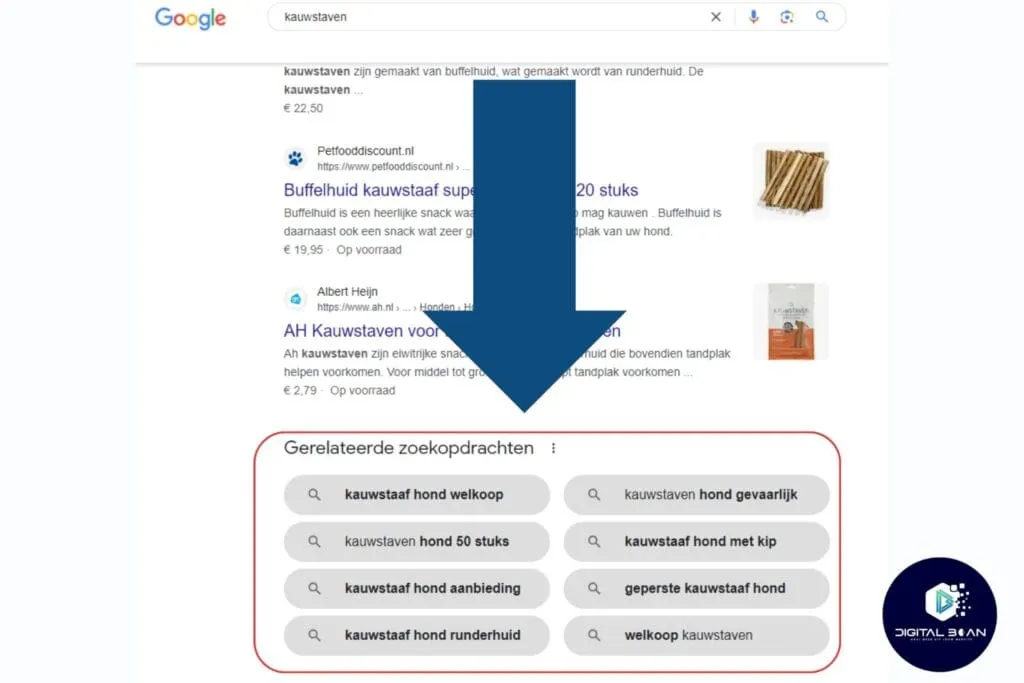
Think of the ‘related searches’ at the bottom of your search results (see image). Pro Tip! Click on one of the related searches and check its ‘related searches’ again! This way, you’ll have the perfect long-tail keywords for your online store in no time!
The “People also ask” section is a goldmine too. It shows what else people ask around the search term. It almost can’t get any easier than that ;)!

Autocomplete is also a great long-tail keyword finder, search your primary keyword with a secondary word, and see what autocomplete gives you.

Google Search Console
Dive into Google Search Console performance. Study the search terms that are already bringing visitors to your site. Find long-tail variations of these terms.

Then create content around these terms, since you’re already ranking for these terms, you’ll probably rank fairly easily for these long-tail terms too.
On one of our test websites, we saw that we were ranking well for ‘dual basket air fryer’ with our pillar post (main blog post) ‘best air fryer’. So we created a piece on the best dual basket air fryer, and that post stayed at the top of the search results for months

Google Trends
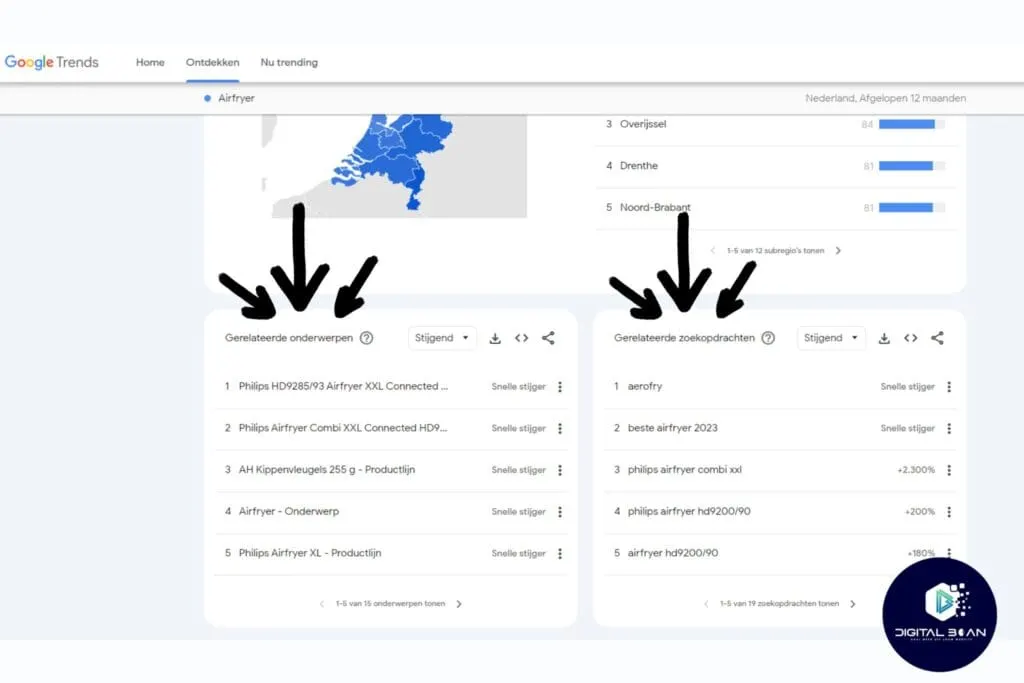
Use Google Trends to check the popularity of potential long-tail keywords.
Look for trends in searches related to your main topic.
Identify long-tail keywords that are growing in popularity and work them into your content, and ride the trend wave! 😉
Online Store Autocomplete
Visit popular online stores in your niche, or big ones like Amazon.
Use their search function and pay attention to the autocomplete suggestions.
These are often based on frequently searched long-tail keywords and reflect direct customer needs and questions.

Forums Are a Goldmine!
Read active forums in your sector.
Pay attention to the specific language and terms people use.
These are often untapped long-tail keywords straight from your specific target audience!

Use AI for Suggestions
Yes, AI (such as ChatGPT) is an SEO trend that’s here to stay!
With a simple ‘prompt’ like: ‘Can you give me 10 long-tail keywords for [main topic]‘ you can already get a whole load of inspiration!
It is smart to check them in an SEO tool first, though, sometimes it gives you variations nobody actually searches for.

Use Long-Tail Keyword Tools
Make use of well-known SEO tools like Ahrefs, SEMrush, or a dedicated long-tail keyword tool like AnswerThePublic (see image), for detailed long-tail keyword research.
These keyword tools offer detailed data on search volume, competition and related searches, which matters for finding the right long-tail keywords for your content strategy.
With these long-tail keyword tools, the time-consuming practices above are no longer necessary!

Using Long-Tail Keywords, Here’s How!
Create Specific Long-Tail Keyword Content
Focus on specific topics that interest your target audience and create dedicated content for them!
This attracts super relevant organic traffic, ready to take action.
Think of specific blog posts, FAQ pages, or detailed product descriptions.
Use Long-Tail Keywords in Your Pillar Posts
Work long-tail keywords into your core articles (pillar posts).
This strengthens your authority on a broad topic and makes it super easy to add internal links to the underlying long-tail content.
Every long-tail content post should also link back to your pillar post, to maximise your visibility in search engines!
Long-Tail Marketing in Google Ads
Use long-tail keywords for your Google Ads campaigns.
These terms are less competitive, and the CPC is often cheaper.
On top of that, you’re responding to your target audience’s specific questions and needs. This increases the chance of conversion, because your ads are more relevant to the searcher.

In Summary
In this blog, we’ve explored the power and importance of long-tail keywords. Here are the key points:
Quick wins! With long-tail keywords, you can rank faster and more easily. They’re less competitive and focus on specific niches.
Relevant Traffic: These keywords attract more relevant, targeted traffic. Visitors who know what they’re looking for convert better.
A Little of a Lot Is Still a Lot! Don’t underestimate it; long-tail keywords make up the largest share of searches on the internet. They open up a world of opportunities.
Finding Long-Tail Keywords: Use tools and tactics like Google Search features, Search Console, Google Trends, and even ChatGPT to find them.
Integration: Work these keywords into your content, from specific blog posts to pillar posts, and even into Google Ads for maximum impact.
Hopefully we’ve been able to answer your question ‘what are long-tail keywords’ and hopefully we’ve shown you the opportunities they offer!
Want to seize those opportunities effectively without doing the time-consuming work yourself? Then get in touch without obligation! We (Digital Bean) can then look at a suitable SEO strategy together!
If you’re going to give it a go yourself anyway, good luck! See you at the top of the search results!
See you in the next one…