What Is a Search Engine? + The 10 Best-Known Ones!
 Joram BoonSEO and content specialist
18 September 2024 · updated 10 September 2024
What Is a Search Engine?
A search engine is a tool that helps users find information on the web.
Using keywords, you find information in that vast online library of information called the internet!
The search results are shown on a Search Engine Results Page, or SERP. It looks like this…

The SERP is generated using complex algorithms that determine the relevance of pages.
Well-known search engines include Google, Bing, YouTube, DuckDuckGo and Ecosia.
How a Search Engine Works…
A search engine works in 3 steps:
- Crawling: The search engine looks around the internet using “bots” (also known as spiders/crawlers) and collects (new) information from websites.
- Indexing: The search engine stores this information in a database (the index). A kind of giant library.
- Ranking: When you run a search, the search engine looks through its index and shows the most relevant pages.
How Did Search Engines Actually Come About?
Search engines emerged out of the need to find information quickly on the internet.
In the early '90s, plenty of websites already existed, but there was no easy way to search through them.
The first search engines started out simple. They were basically just lists of websites maintained by hand. It looked like this…
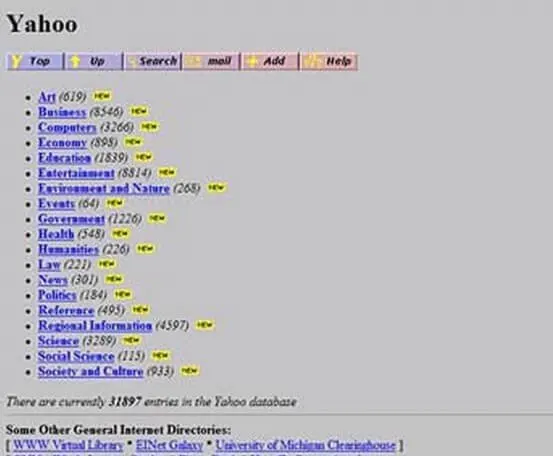
But as the internet grew, this became impractical. (Just think how much work this must have been, unimaginable now)
In 1993, the first real search engine arrived, called Archie, which indexed the content of FTP sites (a kind of early website).
After that came search engines like AltaVista and Yahoo!, which were more extensive and automatically searched websites (crawling).
In 1998, Google launched, and it changed everything…
Google used a new way of ranking, based on how often other websites linked to a website.
It made the search results far more relevant, which quickly made Google the most popular search engine.

But besides Google, there are loads of other search engines, each appealing to a different market. Below, we've briefly covered them…
10 Well-Known Search Engines You Should Know!
1. Google Search Engine

Google is the most widely used search engine in the world, offering fast, relevant search results. (91% of the entire search engine market)
It's popular in North America, Europe and Asia. Google is known for its algorithm, which takes hundreds of factors into account to show the most relevant search results.
Google also offers products like Gmail, Google Maps and Google Drive, which boost its popularity even further.
2. Bing Search Engine

Bing is Microsoft's search engine and offers search results similar to Google's, with a focus on visual presentation and integration with Microsoft products.
Bing is mainly used in the United States and a handful of European countries.
It offers unique features such as reward programmes where users can earn points for searches, and it's increasingly using AI in its SERP.
3. Yahoo Search Engine

Yahoo was one of the first search engines and now offers a wide range of internet services, including news and email.
Yahoo is especially popular in the United States, Japan and parts of Europe.
Although it's used less often as a primary search engine, it remains popular thanks to its extensive online portal that combines search results with other services.
4. DuckDuckGo Search Engine

DuckDuckGo is a search engine focused on protecting user privacy by not collecting or storing personal data.
It's available worldwide and is gaining popularity in countries where privacy awareness is growing, such as the United States and Europe.
DuckDuckGo doesn't track users, doesn't store search history, and doesn't show personalised ads.
5. Ecosia Search Engine

Ecosia is a search engine that works like Google or Bing, but with one important difference: the profits are used to plant trees.
Ecosia is especially popular in Europe among environmentally conscious users.
They invest at least 80% of their profits in reforestation projects, and their transparent reporting makes it an environmentally friendly alternative to traditional search engines.
6. Baidu Search Engine

Baidu is the largest search engine in China and is often called “the Chinese Google”.
It offers search services specifically tailored to the Chinese market and language.
Baidu has a dominant position in China and also offers services such as maps, music and artificial intelligence (AI).
7. YouTube Search Engine

Although YouTube is primarily a video platform, it also functions as a search engine for videos.
With billions of videos and users worldwide, it's one of the largest search engines for visual content.
YouTube was acquired by Google in 2006 for €1.65 billion (Source)! Which is why it now works smoothly with other Google services.
8. Ilse Search Engine

Ilse was one of the first Dutch search engines and was especially popular in the '90s and early 2000s.
Although it's used less today, it played an important role in the early days of the internet in the Netherlands.
Ilse still offers search services, but is now integrated with Startpagina.nl. A nice bit of history nonetheless!
9. Yandex Search Engine

Yandex is the largest search engine in Russia and has a strong presence in other Russian-speaking countries.
Yandex offers a wide range of services, including search, maps, email and cloud storage.
It's comparable to Google in terms of functionality, but with a focus on the Russian language and culture.
10. Brave Search Engine

Brave is a relatively new search engine focused on privacy and speed.
It's developed by the makers of the Brave browser, known for its built-in ad blocker and privacy protection.
Brave Search doesn't show ads or tracking, making it an attractive option for users who want to protect their online privacy.
Those were the 10 search engines you should know…
Now you're probably curious how you can rank better in search engines, and that's called…
Search Engine Optimisation
Everything to do with helping a website rank better is Search Engine Optimisation (SEO).
Although every search engine has slightly different criteria, there are a few universal factors that matter for all of them.
Here they are…
- Keywords: These are the words people type when searching for something. Make sure these words appear naturally on your website.
- Good content: Write useful, interesting SEO copy that people genuinely benefit from and enjoy reading.
- Links to your site: Other websites linking to yours (link building) help you rank higher in the search results.
- Your site's technical setup: Make sure your website loads fast, works well on mobile, and is secure.
- User-friendliness: Make your site easy to use, so visitors are happy to stick around.
- Titles and descriptions: These are the texts you see in the search results. They need to be clear and compelling, so people click your link.
If you get these things right, you're already doing 80% right, and you'll already be able to get great results in the search engines!
Want to hit that 100%? Then you'll need expertise, the kind an SEO specialist can offer…
Want to take your SEO to that 100% and bring in more organic traffic through search engines?
It's completely no-obligation, and you'll get some SEO tips to improve straight away.
So it's a pure win!