What Is Upselling and Cross-Selling?
 Joram BoonSEO and content specialist
28 August 2024 · updated 4 August 2024
Wondering how to increase your average order value without doing much extra?
Discover the power of upselling and cross-selling! These smart techniques help you get more out of every customer by offering them exactly what they need, often before they realised they needed it.
In this article, we explain what upselling and cross-selling are, how you can apply them in your online store, and give you practical tips to get started straight away.
Let's get started…
What Is Upselling?
Upselling is a sales technique where you encourage your target audience to buy a pricier or better product than they originally planned to, for a small additional cost.
Upselling works because it taps into customers' natural wish to get better value. It gives them the chance to get more for their money, and that can be a win-win: your revenue grows and the customer gets a product that better matches their needs.
It's a smart, quick way to raise the average order value while also improving customer satisfaction. But what does upselling really mean, and how does it work in practice? Let's take a closer look.
An example of upselling in the real world…
Picture this: you're at your favourite fast-food chain and you've just ordered a medium portion of fries.
The staff member kindly asks: “Would you like to upgrade to a large portion for just €0.50 extra?” This is a classic example of upselling. The customer is offered a more appealing, but slightly pricier, alternative.
The goal isn't just to get the customer to spend more, but also to give them a better experience.

Upselling in E-commerce
In the world of e-commerce, upselling works in a similar way. It's about tempting your customers to choose an upgrade or a premium version of the product they're already considering. This could include offering:
- An upgraded version: Offer a version of a product with more features or higher quality.
- Larger quantities: Encourage customers to buy a bigger pack for a better price per unit.
- Premium options: Introduce products with extra benefits, such as a longer warranty or exclusive features.
Examples of upselling in e-commerce…
Scenario: A customer is looking for a new laptop in your online store. They're looking at a €600 model.
Upselling options:
- Better specifications: Show a similar model with more memory and a faster processor for €800.
- Extra accessories: Offer a bundle where the customer gets a premium laptop case and mouse for an extra €50.
- Extended warranty: Suggest adding a three-year extended warranty to the laptop for an extra €100.
What Is Cross-Selling?
Cross-selling is a sales technique where a business offers additional products or services to a customer who is already making a purchase.
The goal of cross-selling is to increase the total value of the sale by offering products that complement and enhance the original purchase.
This doesn't just lead to higher revenue, it can also boost customer satisfaction, since customers get products that make their original purchase more useful or more enjoyable.
An example of cross-selling…
Picture this: you walk into a shop to buy a new smartphone. While you're at the till paying, the salesperson kindly asks whether you'd also like a protective case for your new phone.
This case will help your phone last longer and keep looking like new. On top of that, the salesperson also offers a special deal on a wireless charger that's a perfect match for your new smartphone.
This is a classic example of cross-selling: offering products that complement the original purchase.

Why is cross-selling important?
Cross-selling is a powerful technique because it taps into the customer's needs and wants at the moment they're already in buying mode. To repeat: when they're in BUYING MODE, that's important to remember.
Reasons why cross-selling matters for your e-commerce business:
- Higher average order value: By offering additional products, you can increase the total value of every transaction.
- Better customer satisfaction: Customers often feel better served when they're offered products that make their original purchase more useful.
- More chance they'll come back: Satisfied customers are more likely to return for future purchases.
How do you use cross-selling in e-commerce?
Here are a few effective ways to apply cross-selling in your e-commerce store:
- Recommendations on the product page: Show additional products on the main product's page. For example, with a camera you could recommend a tripod and an extra memory card. Check out more optimisation tips for your product page here!
- Bundle deals: Create packages of related products offered together at a reduced price. For example, a laptop with a bag and a mouse.
- During checkout: Offer additional products at checkout. For example, when someone checks out a pair of shoes, you could offer shoe care products.
- Email marketing: Send personalised emails with recommendations for products related to the customer's previous purchases.
Cross-selling is a craft that, done well, can boost both your revenue and customer satisfaction. Try out different strategies and find out what works best for your e-commerce business.
What Is the Difference Between Upselling and Cross-Selling?
Upselling: Say you have a customer who wants to buy a smartphone. When you apply upselling, you offer the customer a pricier version of the same smartphone. Maybe this version has more storage, a better camera or longer battery life. The goal of upselling is to convince the customer to buy a better, and usually pricier, product than originally planned.
Cross-selling: On the other hand, cross-selling focuses on offering related or additional products alongside the original purchase. If that same customer buying the smartphone is also offered a phone case, a screen protector or a charging cable, that's cross-selling. This technique helps customers discover products that enhance or complement their purchase experience.

In short, upselling focuses on offering a better or pricier product than the customer originally planned to buy, while cross-selling suggests additional or related products to enrich the original purchase.
How Can You Use Upselling and Cross-Selling in E-commerce?
Upselling and cross-selling aren't just techniques; they're the secret weapons of every smart e-commerce entrepreneur. To give you an idea of how to work this into your own online store, here are 5 ways to implement it…
1. Checkout page
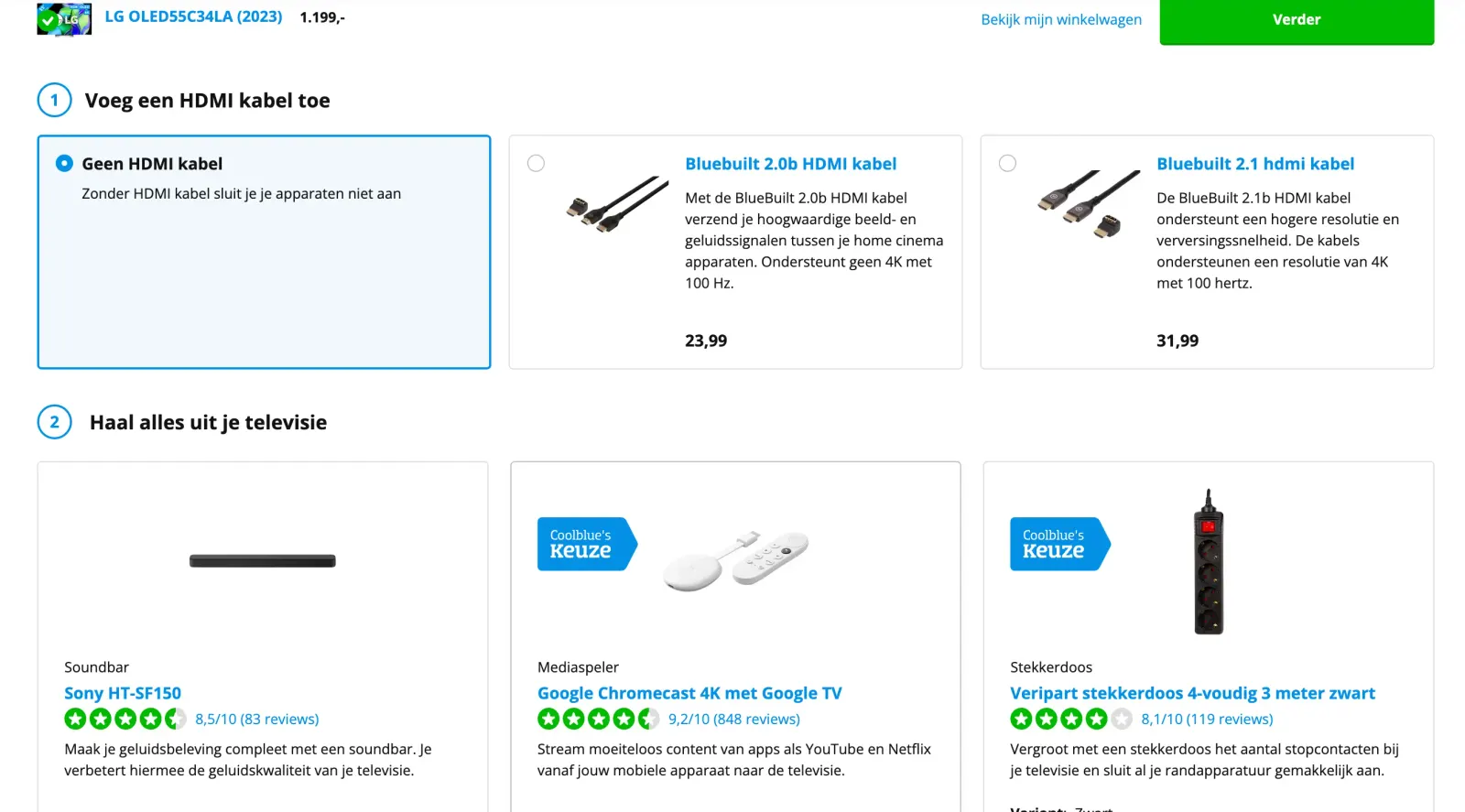
Related products: During checkout, you can offer related products that complement the original purchase. These could be accessories, extra parts or other products that are often bought together.
- Example: If someone buys a TV, you could add HDMI cables, adapters and hubs, as shown below.

Order bump: An order bump is a small offer shown on the checkout page. It's often an impulse purchase that increases the order total without the customer thinking much about it.
- Example: When someone checks out a book, you could offer the audiobook alongside it for an extra fee.

2. Upsells and cross-sells on product pages
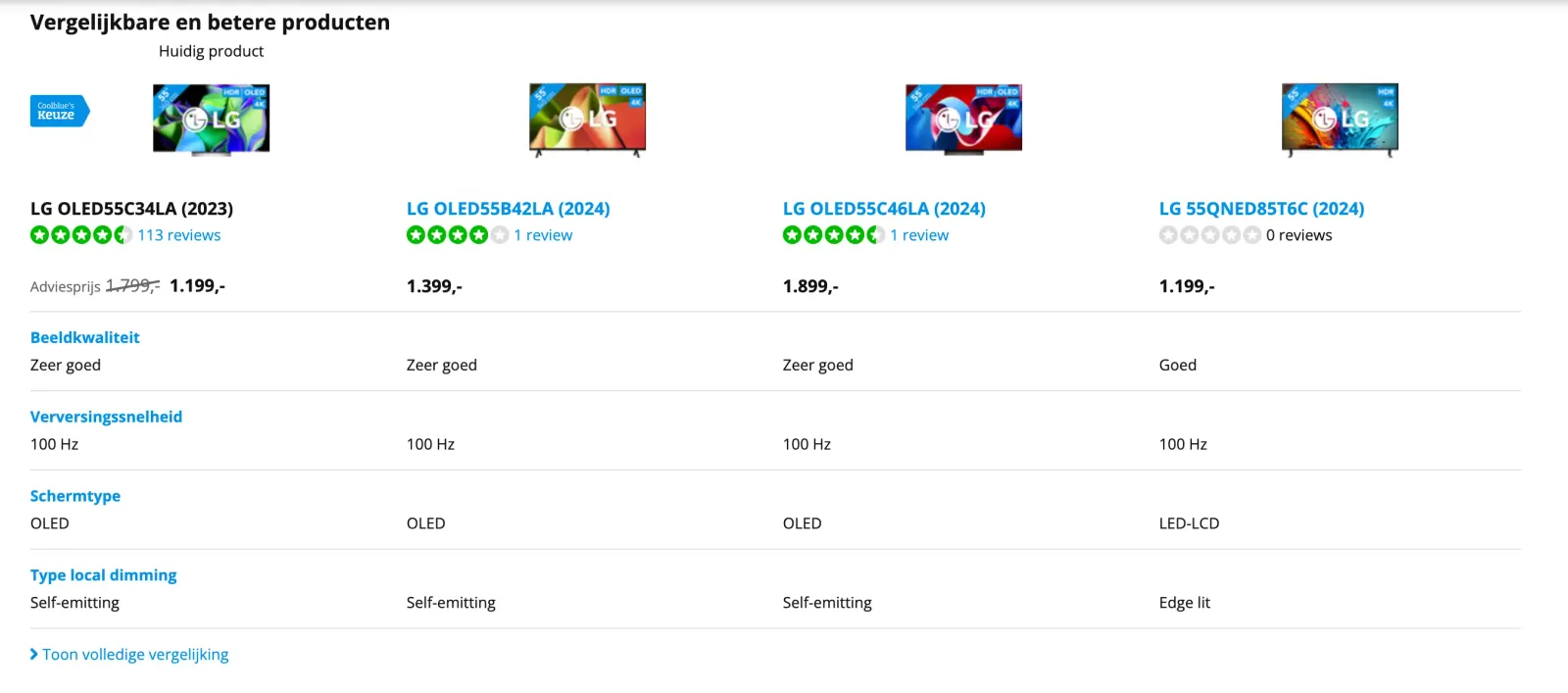
Product page upsells: On the product page, you can tempt customers to buy a pricier or better product. This can be done by showing alternative, more advanced products that offer better features or higher quality.
- Example: For a TV, you show models with a bigger and better screen.
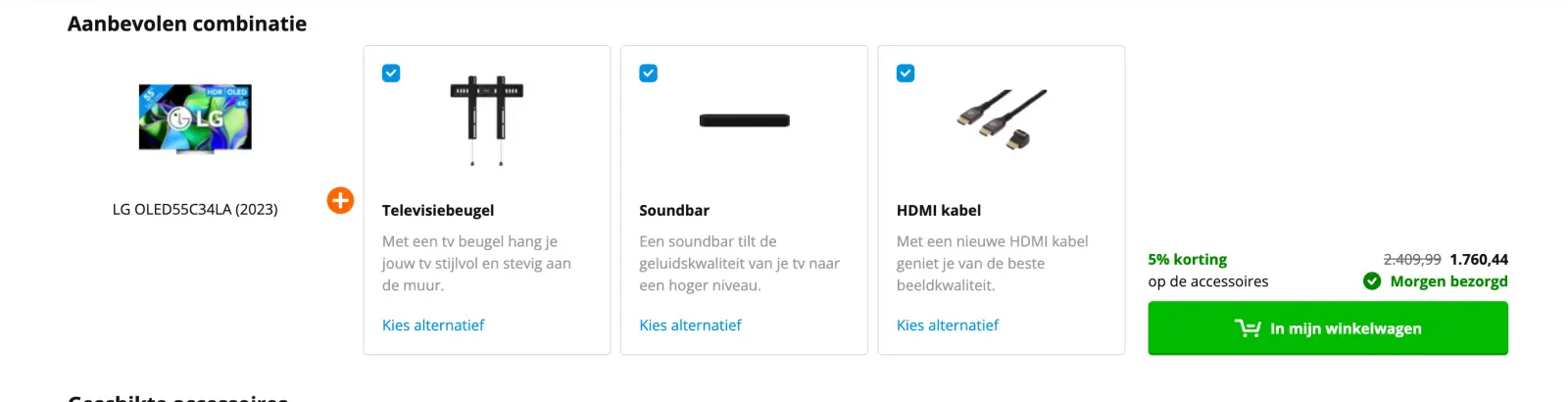
Product page cross-sells: Offer additional products that match the product the customer is viewing. These items are usually shown below the main product information.
- Example: On a TV's page, you could offer a wall mount, soundbar and cables.
3. Separate upsell/cross-sell pages
Specific upsell pages: After a customer adds a product to their basket, you can redirect them to a specific page designed to promote an upgrade of the product.
- Example: After a customer adds a basic smartphone model, they're redirected to a page promoting high-end models.
Specific cross-sell pages: In a similar way, you can create a page that shows only extra related products the customer might also want to buy.
- Example: After adding sports equipment, the customer is taken to a page with sports accessories and clothing.
4. Thank-you page after purchase
Additional offers: After a customer completes a purchase, you can show extra products or offers on the thank-you page. This could be a discount code for a future purchase or directly related products.
- Example: After buying a coffee machine, you offer a discount on coffee beans or special mugs.
5. Bundle deals
Product bundles: Offer products in bundles to tempt customers to buy more. This could be a combination of the main product and a number of complementary products at a reduced price.
- Example: A computer bundle that includes a laptop, a mouse, a bag and a software package.

Careful: Don't Oversell!
The success of upselling and cross-selling doesn't just depend on the techniques you use, but also on how you apply them.
Overdoing it can have the opposite effect and drive your customers away. Here are a few tips for finding the right balance:
Finding balance
Too many upsell and cross-sell offers can lead to irritation and a negative customer experience. Nobody likes a pushy salesperson, and the same goes online. Make sure your offers are subtle and relevant.
Tip: Use no more than one upsell and one cross-sell per purchase process. This keeps things clear and stops customers feeling overwhelmed.
Relevance is key
Make sure the products you offer are genuinely relevant to the original purchase. A customer who has just bought a new laptop is unlikely to be interested in a new vacuum cleaner, but probably would be in a laptop case or a wireless mouse.
Tip: Analyse your customers' buying behaviour and offer products that logically match their interests and needs.
Timing is everything
Choosing the right moment for an upsell or cross-sell can make a big difference. Checkout is an excellent moment for cross-selling, while upselling works better while someone is browsing product pages.
Tip: Use pop-ups or recommendation sections at the right moments, but avoid overloading your customer with too many suggestions at once.
Focus on the customer
Customer satisfaction should always be the top priority. Make sure your upsell and cross-sell offers provide genuine added value for the actual customer.
To Sum It All Up…
Upselling and cross-selling are powerful tools that can help you significantly increase your online store's revenue.
By using these techniques strategically, you can raise your customers' average order value without having to spend extra on marketing to attract new customers.
Let's run through the key points once more:
- Upselling: Offering a pricier or better version of the product the customer is interested in.
- Cross-selling: Offering additional products that complement the original purchase.
- Strategic use: Place upsell and cross-sell offers at logical points in the customer journey, such as on product pages or at checkout.
- Finding balance: Make sure you don't overdo your offers, to avoid irritating customers.
Now that you understand the basics of upselling and cross-selling, it's time to put these techniques into practice. Want help with this?
Book a free call here with our experts at Digital Bean!
Get tailored advice and discover how smart upselling and cross-selling techniques can increase your revenue.