
If you don't know HOW people search, can you write content that people (and search engines) actually want to read?
No, that becomes incredibly hard!
Writing content is a time-consuming process: research, writing, dotting every i. It takes time, and nothing is more frustrating than content that disappears into the sea of Google’s index of some 400 billion unique URLs. A solution…
KEYWORDS.
The words that tell search engines what your content is about, and reveal how users actually search. But how do you find them, and how do you choose the right ones? That's where keyword research comes in: a list of relevant keywords for your business.
Here's what you're going to learn:
- What keyword research is.
- Why you should use it.
- A step-by-step approach to carrying out keyword research.
- The importance of search intent and how it shapes your content.
- An overview of the best tools you can use, including FREE tools.
- Common keyword research mistakes and how to avoid them.
What Is Keyword Research?
Keyword research is the process of finding and analysing the search terms people use in search engines. The goal is to understand which words and phrases your audience uses, so you can tailor your content to match.
This research is indispensable for search engine optimisation (SEO), because it helps improve your website’s visibility and attract relevant traffic.

Why Do Keyword Research at All?
Keyword research is genuinely the secret weapon behind a smart online marketing strategy. It's like having a direct line to WHAT your customers want and HOW they search for it.
Without this insight, it's like feeling your way around in the dark. But with the right keywords, you don't just get found more easily; you also attract visitors who are already looking for exactly what you offer. In short, it's your way of saying: “Hey, I've got exactly what you need!”
So, why does it matter so much?
- Understand what your audience wants: You learn to speak your audience's language and understand their needs.
- Improves your visibility: Search engines understand your content better and can rank you for related search terms.
- Attracts the right visitors: People who find what they're looking for are happier visitors.
- Finds unique opportunities: Spot opportunities others are missing. Solve problems for users that haven't been solved yet.
- Creates content that connects: Write about what genuinely resonates with your audience and is exactly what they're searching for!

How Do You Carry Out Keyword Research?
How do you carry out keyword research? Don't worry, we've kept it simple.
Follow the simple steps below and practical tips, and you'll be up and running in no time!
1. Understanding your target audience
Before you start your research, it's important to understand what your audience needs and which problems or pain points they have. Ask questions such as:
- Who are they?
- Which problems or pain points are they trying to solve? Or, ‘What dream outcome are they looking for?’
- What solution are they searching for?
- Which of your products or services solve this?
- Where on the internet do they search for these solutions?

2. Make a list of potential keywords to start with
Let your creativity run free in a brainstorming session. Grab a whiteboard or a large sheet of paper and write down everything that comes to mind about your business, products or services.
Think about the problems you solve, the benefits you offer, and even the questions customers often ask. Involve your team in this session – sometimes the best ideas come from unexpected places.
This is the moment to think broadly; filtering and focusing comes later. Write down every word or phrase that comes to mind and seems even slightly relevant. This forms a solid starting point for building out your keyword research.

3. Finding and analysing keywords with tools
Time to turn our brainstormed ideas into a concrete list of interesting keywords using analysis tools. By running your ideas through tools such as Google Keyword Planner, SEMrush or Ahrefs, you discover exactly HOW people search.
These tools show search volumes (how often something is searched for each month) and give insight into the popularity and competition of each keyword.
Now you can refine your brainstormed list into an organised overview of keywords that really matter to your audience, sorted by search volume. This helps you focus on the terms most likely to bring traffic to your website.
More on the tools you can use for your keyword research in a moment!

4. Find the search intent behind the keywords
Search intent refers to what people actually hope to find when they run a search. Understanding this matters, because it determines what type of content you need to create to reach them. There are basically four types of search intent:
- Informational: People are searching for information or answers to questions. For example: ‘What is SEO?’
- Navigational: Searchers want to find a specific website or page. For example: ‘Facebook login’.
- Transactional: Here, someone wants to make a purchase or carry out some other kind of transaction. For example: ‘buy iPhone 12’.
- Commercial investigation: Users are in the research phase before a purchase and are comparing options. For example: ‘best wireless earbuds 2023’.
‘How do I figure out search intent?’ I hear you thinking already. Don't worry! Here are a few ways to work it out quickly:
Look at the word choice: Start by looking at the search queries themselves. Specific words like “buy”, “how to”, or “what is” can already say a lot about the intent.
Check the SERPs: Search for your keyword on Google and look at the first page of results. The nature of the top pages (informational articles, product pages, tutorials) gives insight into the search intent and the type of content people want.
Use keyword tools: Some SEO tools such as SEMrush give insight into search intent by analysing how similar keywords perform and are categorised.
By analysing your keywords with these intents in mind, you can write SEO content that matches exactly what your audience is searching for.
>> Read the blog about search intent here! <<

5. Find long-tail keywords with low competition
Long-tail keywords are longer, more specific phrases (3+ words) that are more specific than general search terms and often have less competition.
Because they're usually so specific, they help you avoid the battle for attention that comes with broad search terms, and reach the right people directly, people who already know better what they want.
How do you find them? Think like your audience. What would they type if they were searching for something really specific?
SEO tools such as ‘Answer The Public’ show you which questions are out there.
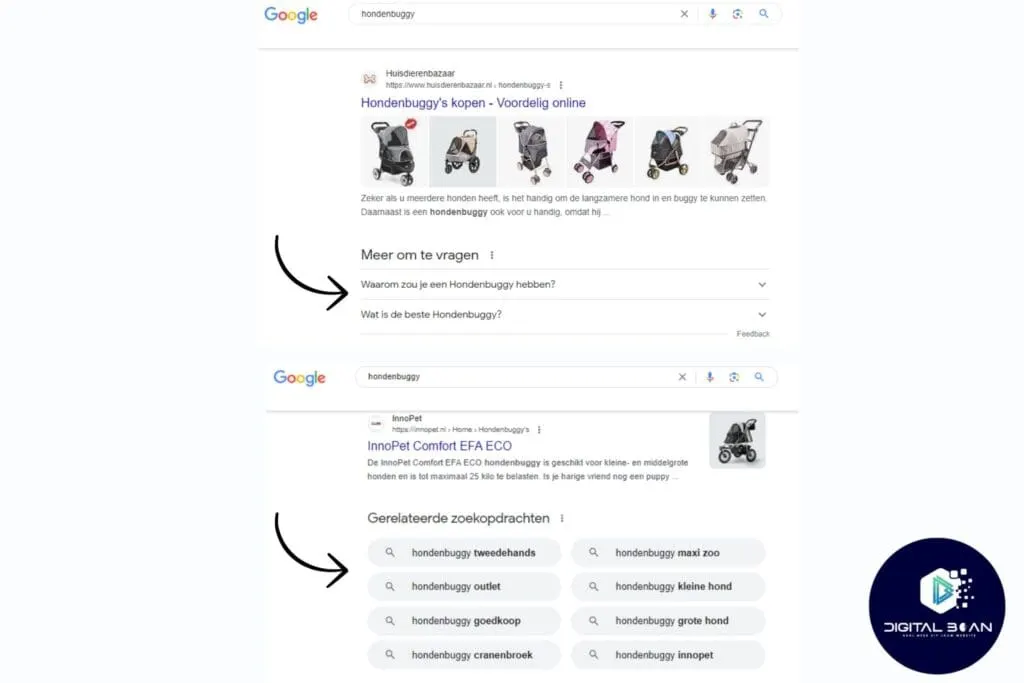
And a quick look at Google’s ‘People also ask’ and ‘Related searches’ at the bottom of the results page (SERP) gives you a great source of long-tail inspiration.
Want to know more? Check out our blog about long-tail keywords here!
6. Select and prioritise
Not all keywords are equal. Not exactly a fashionable thing to say, but it's true. 😉
Here's how to select and prioritise:
Go for relevant terms: If the keyword has nothing to do with your product or service, leave it aside. Only traffic that's genuinely interested in what you offer is worth chasing.
Find the search volume sweet spot: High search volume sounds attractive, but it often means fierce competition too. Look for keywords that strike a good balance between decent volume and realistic ranking chances.
Look at who your competitors are: Take the time to analyse who's already ranking for your chosen keywords. If you think you can do better, that's a good sign you're on the right track.
Go for conversion-focused keywords: Some keywords attract browsers, others attract buyers. Focus on keywords that are likely to lead to action or sales.
Diversify your keyword portfolio: Don't put all your chips on one number. A mix of broad and specific keywords increases your chances of attracting both plenty of traffic and highly targeted traffic.
By following this approach, you make sure your keyword list doesn't just bring traffic to your site, but traffic that actually generates revenue.
7. Categorise the keywords by topic.
Now that you have an extensive list of keywords, it's time to sort them. You do this by assigning each keyword to a specific topic or theme. The goal? Creating a structured approach for your content and SEO strategy. Here are concrete steps, and the reasons why this matters:
Steps for categorising keywords:
-
Create main topic groups: Look at your list and identify the main topics that match your products, services, or common customer questions. You can simply use your common sense here.
-
Assign keywords: Place each keyword under the most relevant main topic. A keyword can sometimes fit in more than one group; choose the group where it has the most impact.
-
Use a spreadsheet: Keep your categorised keywords in a spreadsheet for clarity and easy adjustments down the line.
By categorising your keywords, you end up with a clear list of main topics with the related keywords underneath. That makes it easy to build a content strategy and see what you can write about and which keywords you're going to use. It looks roughly like this…

Now you're done with your keyword research, but as promised in step 3, we'd still cover a few tools and tricks you can use to find keywords. So here they are: 7 tools and tricks for doing keyword research…
Keyword Research Tools
Ahrefs
Ahrefs is extremely well suited to competitive analysis and estimating search volumes. It's a comprehensive SEO tool that helps not only with keyword research, but also with analysing competitors' backlink profiles and much more. We personally use this tool!
- Advantages of Ahrefs:
- In-depth competitive analysis: The ability to thoroughly analyse competitors' SEO strategies, including their backlinks and the keywords they rank for.
- Extensive keyword data: Offers detailed information on keyword difficulty, search volume and estimated clicks, helping users make informed decisions.
- Content explorer: Lets you discover popular content within your niche, which is useful for content marketing and link building strategies.

SEMrush
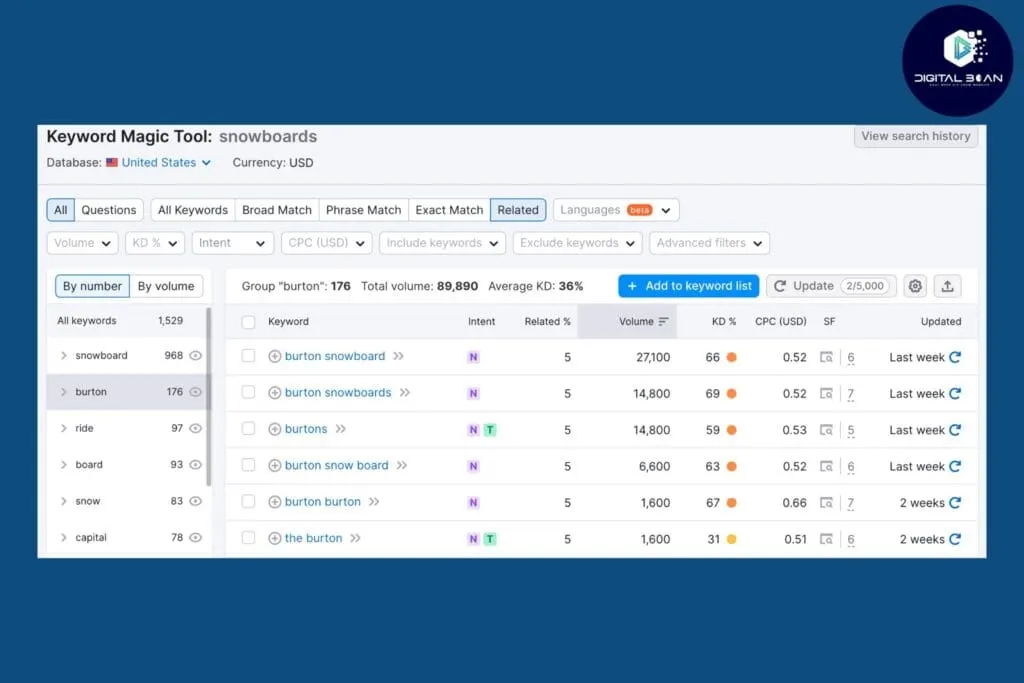
SEMrush offers detailed insights into keywords, competitor analysis and SEO audits. It's a tool that helps both beginners and advanced users optimise their online visibility. Definitely a great tool too!
Advantages:
- Keyword Magic Tool: A powerful feature that offers thousands of keyword ideas, organised by theme, making it easy to find relevant keywords.
- Trend analysis: Helps identify emerging trends within your market, so you can create content that responds to what's happening right now.
- SEO audit tools: Provides comprehensive website audits to identify SEO opportunities and issues, from technical SEO to on-page optimisation.
Answer the Public
Answer the Public is perfect for finding the questions people ask around your core keywords. It's especially useful for generating content ideas and additions that match what people are actually searching for.
Advantages of Answer the Public:
- Question-driven insights: Quickly generates the questions real people ask around your keywords, helping you create targeted content.
- Comparable search terms: Gives insight into how your keywords are used together with examples and comparisons, opening up new content opportunities.
- Visual display: The data is presented in a visual ‘question wheel’, making it easy to quickly spot patterns and themes.

Google Keyword Planner
Although originally designed for Google Ads campaign planning, Google Keyword Planner is also extremely well suited to SEO keyword research. It offers valuable insight into search volumes and keyword competition.
Advantages of Google Keyword Planner:
- Accurate search volume data: Comes straight from Google, giving you reliable estimates of monthly search volume.
- Competition insights: Gives an overview of the estimated competition for each keyword, useful for both SEO and SEA strategies. Curious what we can do for your Google Ads, click here and find out what we can do for you!
- Keyword idea generation: Generates suggestions for related keywords, which can help you expand your keyword strategy.

Google Search Features
Google Search has fantastic resources you can use for instant keyword inspiration. Look at the autocomplete suggestions, the “People also ask” section, and related searches on the results page (SERP).
The advantages:
- Better insight into search intent: Offers real-time insight into what users are searching for and their intentions.
- Free and simple: No extra tools needed; accessible directly through Google Search.
- Long-tail keyword ideas: Helps you find long-tail keywords you can target.
Google Trends
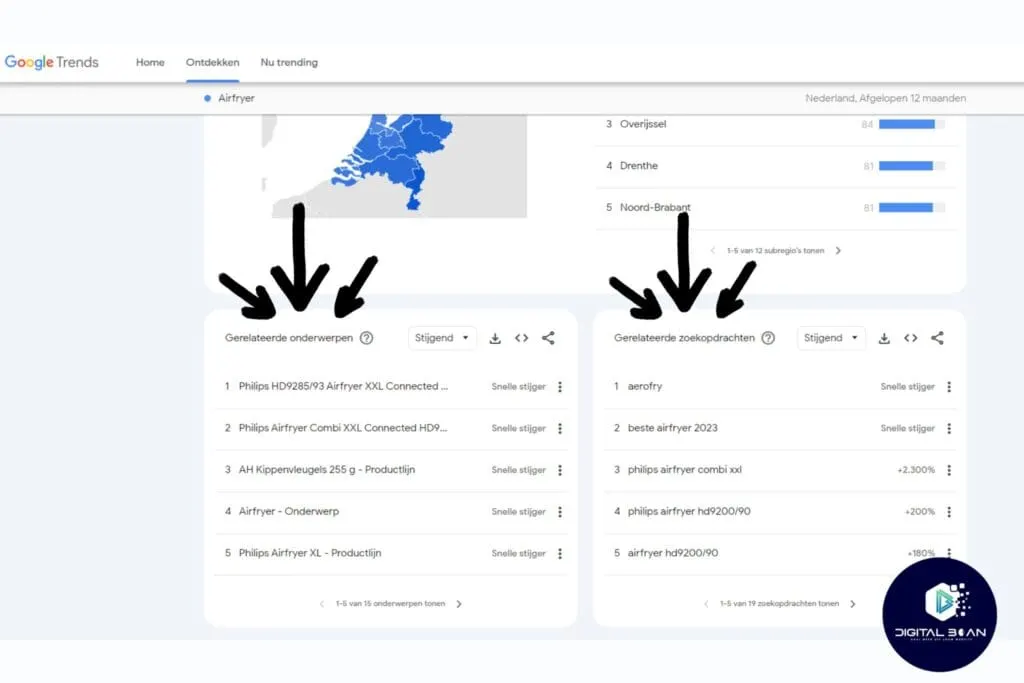
Google Trends is most useful for spotting seasonal trends and the popularity of keywords over time. It's perfect for planning timely content and identifying trending topics.
Advantages of Google Trends:
- Seasonal trend analysis: Identify when specific keywords become more popular.
- Keyword comparison: Compare the popularity of different keywords to work out which ones are most valuable for your strategy.
- Geographic insight: Shows where certain keywords are more popular, which can help with targeting specific markets or regions. Ideal for local SEO if you run a physical shop or service!
Common Mistakes in Keyword Research
Keyword research is the backbone of SEO. However, certain mistakes can undermine your strategy. Here are the main pitfalls to avoid:
Ignoring search intent
Search engines like Google use advanced algorithms to understand the intent behind a search, and reward content that matches it with higher rankings.
Ignoring search intent can cause your content to rank lower in the search results, because it doesn't match what users are actually looking for.
To rank well, it's therefore vital to analyse the underlying need behind a keyword and align your content with it precisely.
You can easily work this out by looking at the current content in the search results.

Only going for high-volume keywords
High-volume keywords are naturally appealing because of their potential to bring in a lot of traffic, but they often come with high competition and lower conversion rates.
Also focus on keywords that show clear purchase intent, even if they have a lower search volume.
Sometimes you're better off with a keyword that gets 20 searches a month but has VERY high and specific purchase intent, than a highly competitive keyword you rank poorly for, or that brings in irrelevant traffic.
Ignoring long-tail keywords
Long-tail keywords are more specific and often less competitive, which makes them perfect for attracting highly relevant traffic.
They let you target users who are closer to making a purchase decision.
Ignoring long-tail keywords means leaving potential opportunities on the table, terms with a high chance of converting. Such a waste!

The End of Your Research!
After working through the steps and tools for how to do keyword research, we've finally reached the end.
Let's recap everything one more time:
- Keyword research is the foundation of every successful SEO and online marketing strategy.
- Understanding search intent and user needs helps you attract targeted traffic.
- Using the right tools makes the process more efficient and more effective. Think of Google Search features or paid tools such as Ahrefs and Answer the Public.
- Avoid common mistakes such as ignoring search intent and long-tail keywords!
The importance of solid keyword research can't be stressed enough. It's the foundation and backbone of SEO for attracting quality traffic to your website!
Still not sure where to start, or don't have the time? Don't worry! Digital Bean's SEO specialists are ready to deliver a killer keyword research with an honest, transparent, and above all, results-focused approach!
Book a call here and see how we can help you with your keyword research for online success.
Speak soon!